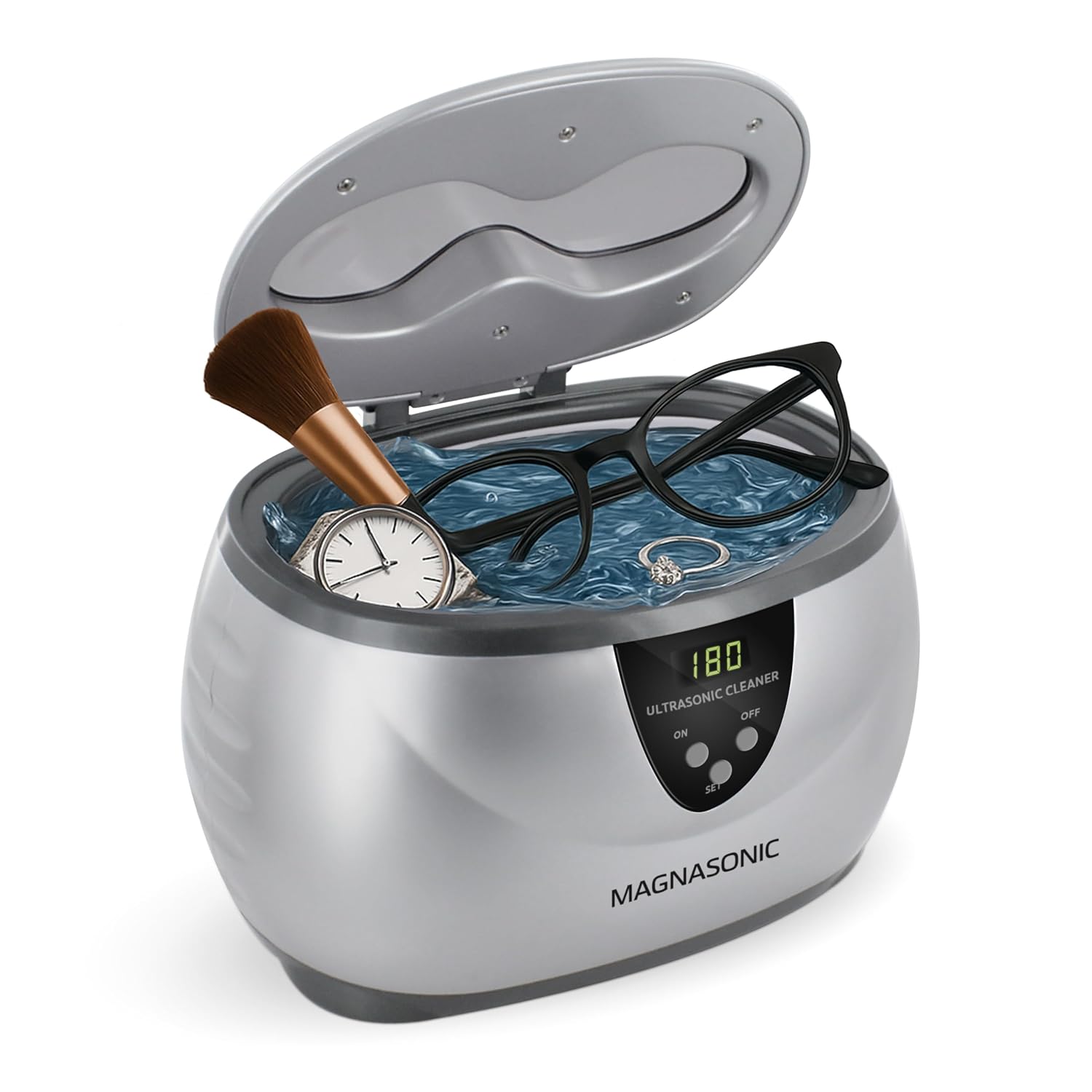
The Magnasonic Ultrasonic Jewelry Cleaner is a compact ultrasonic cleaner designed for cleaning jewelry and other small items using water and high-frequency sound waves.
Ultrasonic cleaners can be very effective at removing dirt, oils and residue from areas that are difficult to reach by hand. However, not every piece of jewelry or every gemstone should be cleaned ultrasonically. Knowing when to use an ultrasonic cleaner is just as important as knowing how to use one.
The Magnasonic cleaner uses 42,000 Hz ultrasonic waves to create microscopic agitation in the cleaning liquid. This action helps loosen dirt and residue from jewelry surfaces, settings and small spaces that can be difficult to reach with a cloth or brush.
The unit has a 20 oz (600 mL) tank and five preset cleaning cycles. For routine jewelry cleaning, water may be sufficient for removing light surface residue. A suitable jewelry-cleaning solution may be used when appropriate for the jewelry being cleaned.
Ultrasonic cleaning can work well for many durable metal jewelry pieces, particularly when the construction, gemstones and finishes are suitable for this type of cleaning.
Before placing jewelry in an ultrasonic cleaner, consider every material in the piece. A jewelry item may contain a durable metal but also include a gemstone, pearl, surface treatment or setting that requires gentler care.
Pearls and other delicate or porous organic materials should not be cleaned ultrasonically. Some gemstones, treated stones, plated surfaces and jewelry with fragile settings may also be unsuitable.
Ultrasonic vibration can also reveal an already loose stone or weakened setting. Jewelry with questionable settings, damaged components or delicate construction should be inspected before ultrasonic cleaning.
When you are uncertain about a particular gemstone or piece of jewelry, use a gentler cleaning method instead.
Many Oliver Hampel designs use intentional matte or satin surfaces. These finishes are part of the character of the jewelry and should not be treated like highly polished metal.
Ultrasonic cleaning itself does not polish a surface in the same way that an abrasive polishing cloth does, but the jewelry should still be evaluated as a complete piece before cleaning. Gemstones, pearls, oxidized areas, plating and other surface treatments may require different care.
Check the jewelry carefully before cleaning, particularly stone settings and other small components. Fill the cleaner according to the manufacturer's instructions and place suitable jewelry in the cleaning basket rather than directly against the bottom of the tank.
Start with a short cleaning cycle. After cleaning, inspect the jewelry, rinse it when appropriate and dry it thoroughly with a soft cloth.
More cleaning time is not necessarily better. Several short cleaning cycles are preferable to unnecessarily prolonged ultrasonic exposure.
An ultrasonic cleaner can be useful for suitable jewelry, while other pieces are better cared for with a cleaning solution, soft cloth or gentle hand cleaning. Choose the cleaning method according to the materials and finish of the jewelry.