
Most people picture a desktop machine squeezing out plastic thread. That is one kind of 3D printing, and it is not this one. The jewelry on this site is made by fusing fine nylon powder with a laser, one hundred-micron layer at a time, inside a sealed chamber — a process called selective laser sintering, or SLS. It produces something closer to a solid, slightly matte ceramic than to anything you would recognize as plastic.
Here is the whole sequence, from an idea to something you can put on.
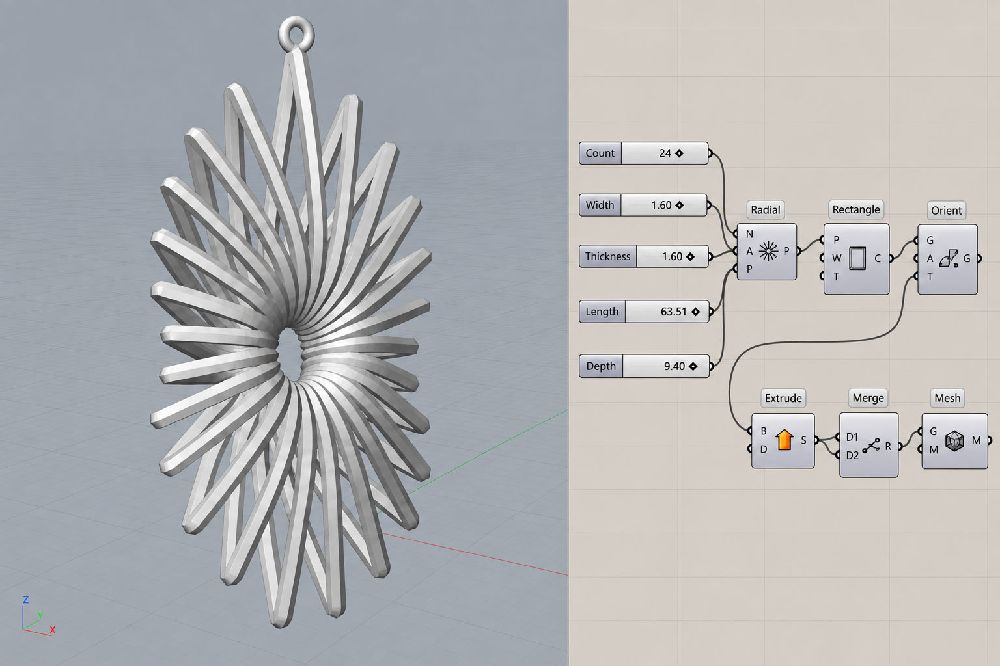
The forms in this collection are not sketched and then modeled. They are described.
I work in parametric CAD — Grasshopper and Rhino — which means a piece is built as a set of relationships rather than a fixed shape. A curve follows a rule. A pattern repeats at an interval that is itself a variable. Change one number and the whole form reorganizes around it: the lattice tightens, the spiral opens, the wave shifts.
That sounds abstract, and in practice it is deeply hands-on. A piece usually goes through dozens of versions before anything gets printed. Most of them are wrong in ways that are only obvious once you see them. But it means I can explore a form the way you would explore a landscape, rather than committing to one drawing and carving toward it.
It also means every piece carries its own logic. The forms are not decorated; they are grown.
Inside the machine is a bed of nylon powder — extremely fine, about the consistency of flour — held just below its melting point. A laser traces the cross-section of the piece across the surface, and everywhere it touches, the powder fuses. A blade spreads a fresh layer over the top, perhaps a tenth of a millimeter thick, and the laser traces the next cross-section. Then again. A build can run for many hours.
The important part is what surrounds the piece while this happens: unfused powder, on every side. It holds the piece in place as it forms.
That single fact is why this jewelry can look the way it does. Casting requires a mold, and a mold has to come apart — which means no undercuts, no enclosed voids, no geometry that traps the mold inside itself. Printing with a filament machine requires support structures, which have to be reachable afterward to be removed, and which scar the surface where they attach.
Powder needs neither. The piece is supported everywhere and touched by nothing. Hollow interiors, interlocking elements printed already interlocked, lattices with no way in or out — all of it is ordinary here. Several pieces in the collection exist only because this is true of the process.
There is a second consequence, and it is the reason a studio like mine can work this way at all. A mold is a fixed cost that has to be spread across a production run, which is why traditional manufacturing pushes toward making many identical things. There is no mold here. A single piece costs what a single piece costs. That removes the pressure to design for volume, and it is why this collection can hold forms that would never survive a manufacturing meeting.
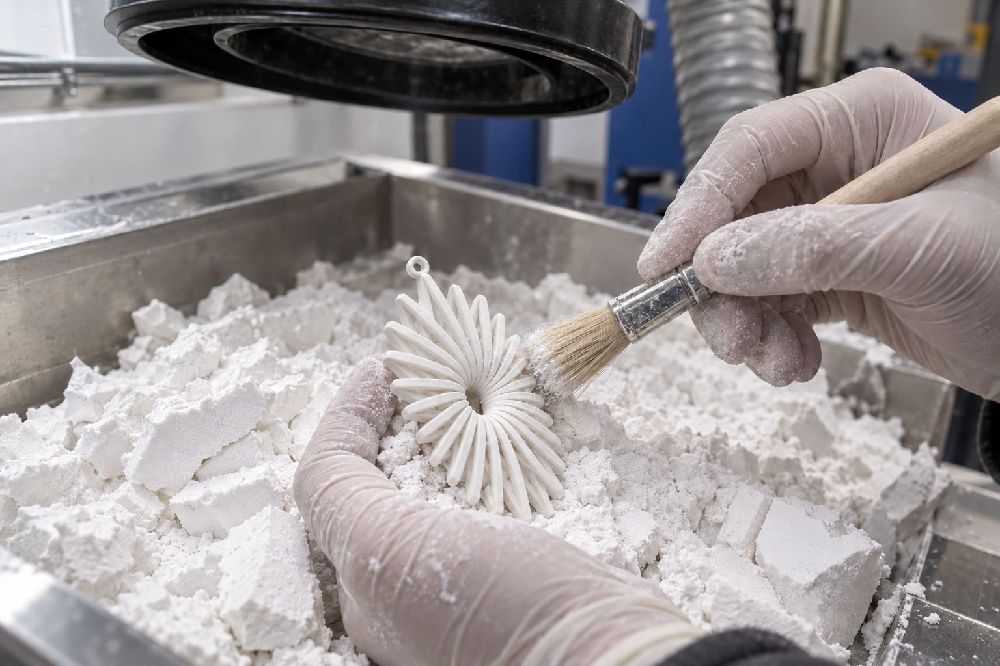
When a build finishes, it does not come out immediately. The chamber has to cool slowly, still full of powder, or the pieces distort as they contract.
What emerges is a solid block of caked powder with the pieces buried somewhere inside it. They are excavated by hand, then blasted clean with fine media to drive the last of the unfused powder out of every recess. What you have at that point is the true raw state: a matte, slightly granular, bone-white object. It already has its final geometry. It has none of its character.
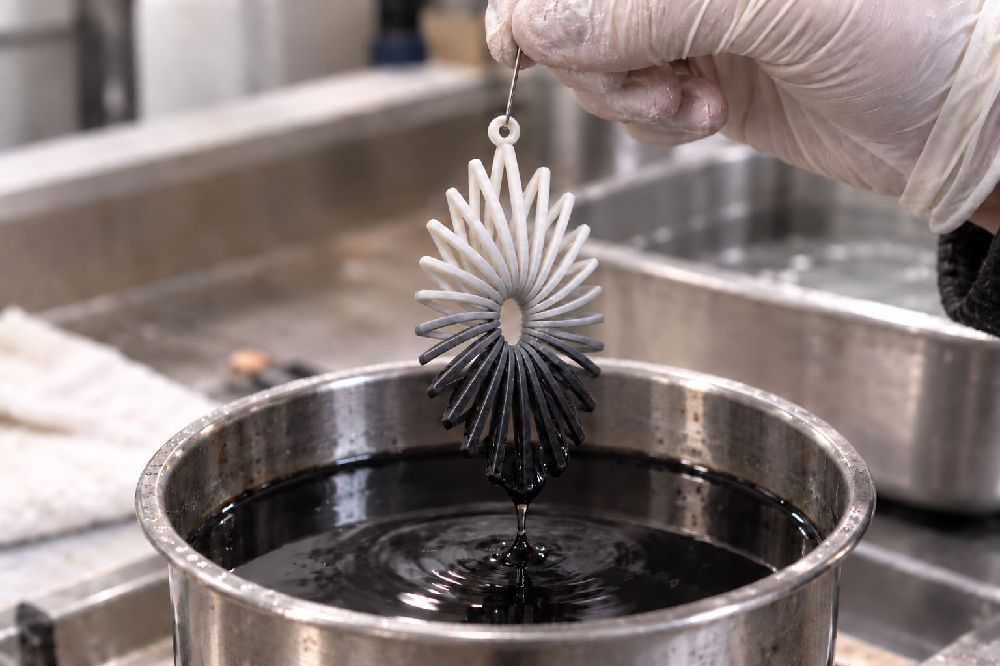
The pieces are then dyed in a heated bath. The nylon draws the color into itself, the way a natural fiber takes dye.
This is the part worth being precise about, because it is often overstated. The dye penetrates the surface — far enough that ordinary wear will never reach through it — but it does not travel all the way to the middle. Cut one of these pieces in half and you would find white nylon at the center.
What matters is the difference between that and a coating. There is no layer of paint or plating sitting on top of the form, so there is nothing to chip, flake, or wear through at an edge. And because it is a bath rather than a spray, the color reaches everywhere the liquid reaches — down inside an open lattice, into the recesses of a deep form, places a spray gun could never have got to. The inside of a piece is the same color as the outside.
Nylon makes the form. It does not make good ear wires.
Earrings are hung on sterling silver ear wires and posts, some of them plated in 18K gold. The part that passes through your ear is always metal, and that is deliberate.
Pendants go the other way. The bail is printed as part of the form, in the same operation as the rest of the piece, so a pendant is one continuous object — no join, no findings, and no metal touching you anywhere.
An earring the size of a small sculpture that weighs almost nothing. A pendant at a scale that would be absurd in cast silver, sitting properly on a chain. Forms with an inside as considered as the outside, because there was never a molding step forcing them to be solid.
It does not tarnish. Water does not trouble it. It will not bend out of true if it lands on a tile floor. Warm water and a soft brush is the entire maintenance routine.
The design, the finishing and the assembly are mine, in Naples, Florida. The sintering itself is done by a specialist printing house — an SLS machine is an industrial installation, not a studio tool, and the people who run them well run them constantly.
That division is worth stating plainly, because it is how most jewelry has always been made. Silversmiths have used casting houses for a very long time. The judgment sits in the design and in what happens to the piece after it comes out of the powder — which is where I have always thought the interesting part was anyway.
Before you buy:
Once you own a piece, and for the curious:
See the full 3D printed collection, or browse earrings and pendants.
All of these are collected on the 3D printed jewelry page.
